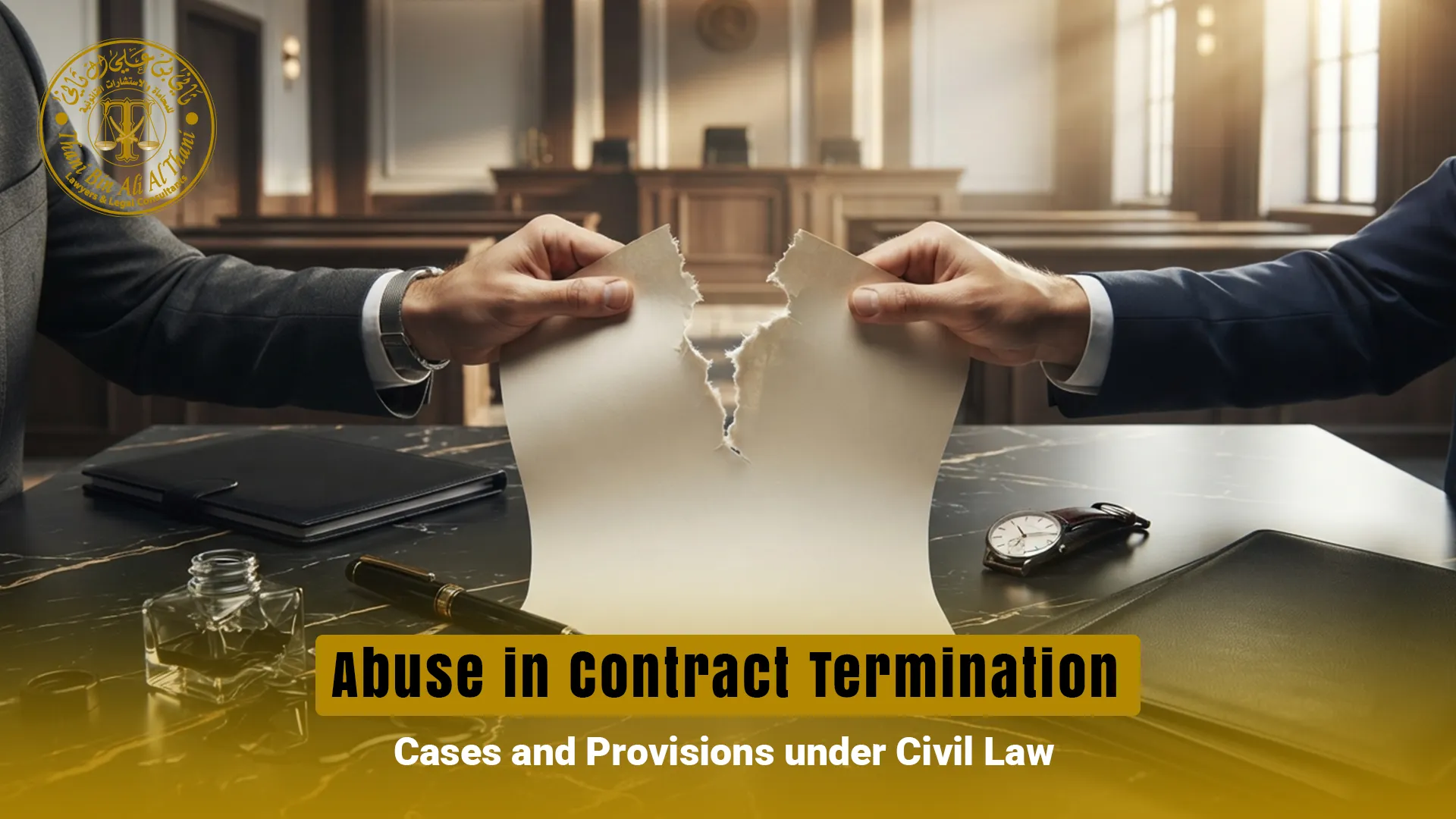

Not every termination is lawful, even when based on a legal right. Abuse in contract termination is considered one of the most significant legal issues that gives rise to extensive debate in practice due to its connection with the principle of good faith and the limits governing the exercise of rights.
In essence, contracts constitute a binding agreement between two legal persons, whether natural or juridical, concerning a specific subject matter capable of existence and based on a lawful cause, such as contracts of sale, lease, partnership, construction, and other civil and commercial contracts.
A breach of the obligations arising from such contracts by either party gives rise to a legally established right to seek rescission, which is among the strongest civil remedies enacted by the legislator to preserve contractual balance and protect the rights of both parties.
However, rescission is not deemed lawful in all circumstances; rather, it may become an instrument of harm when exercised without justification or outside its proper legal scope. Here emerges the concept of abuse in contract termination as a fundamental legal issue affecting the principle of contractual justice and the principle of good faith governing the performance of all contracts.
What, then, distinguishes lawful rescission from abusive rescission? What limits has the legislator established to protect the aggrieved contracting party? And how has the judiciary addressed this issue in its rulings?
This article answers these questions through detailed analysis, precise legal grounding, and comprehensive practical illustrations.
What Is Abuse in Contract Termination under Civil Law?
Rescission is the dissolution of a contract resulting from one contracting party’s breach of its obligation, whereby the other contracting party may, after serving notice of default, seek rescission of the contract together with compensation where appropriate, pursuant to Article (183) of the Civil Law.
Contract termination by rescission is divided into two types:
- Lawful Rescission: This occurs where one of the contracting parties fails to perform its contractual obligations, which constitutes a recognized legal ground permitting the other party to seek rescission.
- Abusive Rescission: This refers to the termination of a contract without acceptable legal justification while causing harm to the other party without a legitimate reason.
The distinction between lawful rescission and abusive rescission may be illustrated through the following comparison:
| Element | Lawful Rescission | Abusive Rescission |
|---|---|---|
| Cause | Actual breach of obligation | Without sufficient justification |
| Purpose | Protection of a legal right | Causing harm to another party |
| Effect | Termination of the contract | Liability and compensation |
| Legal Assessment | Permissible | Unlawful |
These cases constitute some of the most prominent forms of abuse in contract termination addressed by legal scholarship and judicial practice.
Why Is Abuse in Contract Termination Considered a Recurring Legal Issue?
The seriousness of abuse does not arise merely from the breach of an obligation, but rather from the use of the legal right itself — namely, the right of rescission — as an instrument of harm.
This is what makes it a dual challenge:
- On the one hand, it disguises itself as an apparently lawful act.
- On the other hand, it leads in substance to unlawful consequences.
What further increases its complexity is that abuse cannot be measured according to a fixed standard; rather, it varies depending on the nature of the contract, whether civil or commercial, as well as the position of the contracting parties and their respective bargaining power.
This reality has produced extensive judicial jurisprudence seeking to define the boundaries between lawful rescission and rescission tainted by abuse, based on the principle that a right may only be exercised within the limits of the purpose for which the law has recognized it.
Read also: Drafting Watertight Commercial Agreements under Qatari Law
When Is Rescission Considered Abusive in the Eyes of the Law?
Abuse in contract termination is among the issues most frequently debated in practical application. Mere reliance upon the right of rescission is insufficient for the rescission to be deemed lawful; rather, such right must be exercised within the scope of the purpose prescribed by law.
Rescission is considered abusive in circumstances where there is evidence of bad faith, absence of legitimate justification, or intent to cause harm to the other party.
Abuse may also arise where rescission is exercised at an inappropriate time or without granting the other party a reasonable opportunity to perform its obligations.
Cases of Abuse in Contract Termination
Among the most prominent forms of abuse in contract termination in practical application are the following:

Termination without Legal Justification
Terminating a contract without acceptable legal grounds with the intention of causing harm to the other contracting party or to third parties, or in a manner contrary to public order and the principles of contractual good faith.
This type is regarded as one of the clearest forms of abuse in legal scholarship and judicial practice because it involves a deliberate intention to inflict harm.
Breach of Essential Obligations
- A contracting party’s total or partial failure to perform its obligation.
- Delay in performance in a manner causing harm to the other contracting party.
- Breach of essential contractual terms, such as price, confidentiality, or delivery obligations.
Legal Basis for Contract Rescission
These rules constitute the foundation upon which abuse in contract termination is assessed:
A. Contractual Rescission
The law grants the contracting parties the right to agree that the contract shall be rescinded automatically without the need for a judicial ruling in the event of non-performance of contractual obligations.
However, the law imposes an essential condition: the rescission clause in the contract must be explicit and clearly indicative of the contracting parties’ intention to effect rescission, and no notice of default to the debtor is required for such rescission to take effect.
If rescission occurs despite ambiguity in the contractual wording and without a clear indication of the parties’ intention to rescind, such rescission becomes tainted by abuse pursuant to Article (184/2) of the Civil Law.
B. Contractual Rescission in Commercial Contracts
This raises a fundamental question: Is an express rescission clause in commercial contracts sufficient to ensure the lawfulness of rescission?
The answer is no. The law imposes an additional mandatory requirement, namely:
The debtor in commercial contracts must be served with notice to perform its obligation, and no exemption from such requirement is permitted. Any agreement between the parties to the contrary shall have no legal effect pursuant to Article (184/3) of the Civil Law.
Accordingly, abuse in the rescission of commercial contracts arises where rescission is effected through an express clause but without serving notice of default, as such notice constitutes a safeguard for the debtor that contractual will alone cannot waive.
Read also: Flexibility of Commercial Contracts in the Face of Economic Crises: Legal Solutions
Rescission and Its Effect on the Special Successor
Rescission of contracts transferring ownership may not be invoked against the special successor who has acquired a real right for consideration from one of the contracting parties. This is subject to the fulfillment of two conditions:
- The special successor must have acquired his right for consideration and in good faith.
- At the time of contracting, the successor must not have known the cause that led to the rescission of his predecessor’s contract, nor could he have known it had he exercised the diligence required of an ordinary person in light of the circumstances, pursuant to Article (186) of the Civil Law.
If the contract is rescinded despite the fulfillment of these two conditions, the rescission is considered tainted by abuse and may not be invoked against the good-faith special successor, such as a purchaser of the property under a contract that was later rescinded without his knowledge of the reason for such rescission.
Is It Permissible to Rescind Contracts Binding on One Party?
Yes, it is permissible; however, its legality is subject to a fundamental condition, namely that the obligation becomes impossible due to an external cause beyond the debtor’s control, pursuant to Article (187/1) of the Civil Law.
Illustrative Example
A person who announces a specific prize, which later becomes impossible to fulfill due to its destruction by fire or damage beyond his control; in such a case, rescission is lawful.
However, if impossibility does not exist and rescission occurs while the debtor is still able to perform, even partially, then abuse in contract termination is clearly established.
Practical Case — Court of Cassation Judgment
Appeal No. 73 of 2016 — Civil and Commercial Circuit — Session of 12/4/2016
The Court of Cassation ruled in a case summarized by the fact that an employer notified an employee under a fixed-term contract of two years (starting from 1/12/2012) of the termination of his service effective 31/7/2013, relying on the transfer of hotel management to another company as justification for termination.
The Court confirmed that Article (52) of Labor Law No. (14) of 2004 explicitly provides that existing employment contracts remain valid in the event of the transfer of an establishment to a party other than its original owner, whether by merger, transfer of ownership, or transfer of management rights, and that the new employer is jointly liable with the former employer for all obligations.
The Court concluded that terminating the employment contract before its expiry on the grounds of transferring the management of the establishment does not constitute a legally acceptable justification. It further confirmed that these provisions are mandatory and related to public order and may not be agreed otherwise. Accordingly, it awarded appropriate compensation to the aggrieved party.
Practical Recommendations for Contracting Parties
Based on the above, a number of recommendations may be made to contracting parties in order to avoid falling into the pitfalls of abuse in contract termination:
- Precise drafting of rescission clauses: The wording of contractual rescission must be explicit and not open to interpretation, with clear specification of the grounds for rescission to avoid any future disputes.
- Compliance with notice requirement in commercial contracts: The requirement of notice in commercial transactions may not be disregarded, regardless of the clarity of wording, as it is a mandatory legal safeguard that cannot be waived by agreement.
- Documentation of reasons for rescission: A party seeking rescission should properly document its reasons and prove the damage resulting from the other party’s breach, in order to prevent any allegation of abuse.
- Respecting the rights of the special successor: When ownership of the subject matter of the contract is transferred, the good faith of the transferee must be respected, and rescission may not be invoked against him unless the legal conditions are met.
- Consulting a legal specialist: Before taking any decision to rescind contracts of significant value or sensitivity, it is advisable to seek advice from a specialized legal consultant to assess the legality and consequences of rescission.
This confirms that abuse in contract termination is not linked only to the existence of the right of rescission, but also to the manner in which it is exercised.

Frequently Asked Questions on Abuse in Contract Termination
When does the right of rescission become legal abuse?
The right of rescission becomes abusive when it is used without a legitimate justification, or with the intent to harm the other party, or in violation of the principle of good faith in the performance of contracts.
Is the Existence of a Termination Clause in a Contract Sufficient for the Rescission to Be Lawful?
No, the mere existence of a termination clause alone is not sufficient. It must be clear and explicit, and it must be exercised within the legal controls; otherwise, the rescission shall be deemed tainted by abuse.
What Is the Importance of Notice in the Termination of Commercial Contracts?
Notice is considered a fundamental requirement in commercial contracts, and it may not be contractually waived. Failure to comply with it results in the termination being regarded as abusive, even where an explicit termination clause exists.
How Does the Judiciary Determine the Existence of Abuse in Termination?
The judiciary assesses abuse based on the circumstances of each case, such as the existence of a genuine justification, the timing of termination, the extent of good faith, and the impact of termination on the other party.
Can a Party Be Held Liable Despite Having the Right to Terminate the Contract?
Yes. If it is established that the exercise of the right exceeded its legal purpose or caused unjustified harm to others, legal liability arises and compensation becomes due.
What Is the Most Important Step Before Deciding to Terminate a Contract?
Ensuring the existence of a clear legal ground for termination, documenting the relevant facts, and complying with procedural requirements such as notice where necessary, in order to avoid the termination being considered abusive.
Conclusion
It becomes clear from the foregoing that abuse in contract termination is a legal phenomenon with multiple dimensions that affect the essence of contractual justice. Termination, whether in bilateral or unilateral binding contracts, is permissible when its legal grounds are satisfied, such as non-performance or impossibility due to an external cause.
Otherwise, it becomes tainted by abuse, which consists of the use of the right of termination with the intent to cause harm, in violation of public order, or through breach of essential obligations such as non-performance, defective performance, or exploitation of the other party’s need or weakness.
Likewise, a neighbor may be prevented from exercising the right of use if such use is unlawful, excessively harmful, or exceeds customary limits of neighborhood harm, in protection of the principle prohibiting abuse of rights, which is one of the most established principles of modern civil law.
Abuse in contract termination remains one of the most prominent forms of misuse of rights, which requires contracting parties to exercise caution when deciding to terminate contracts.