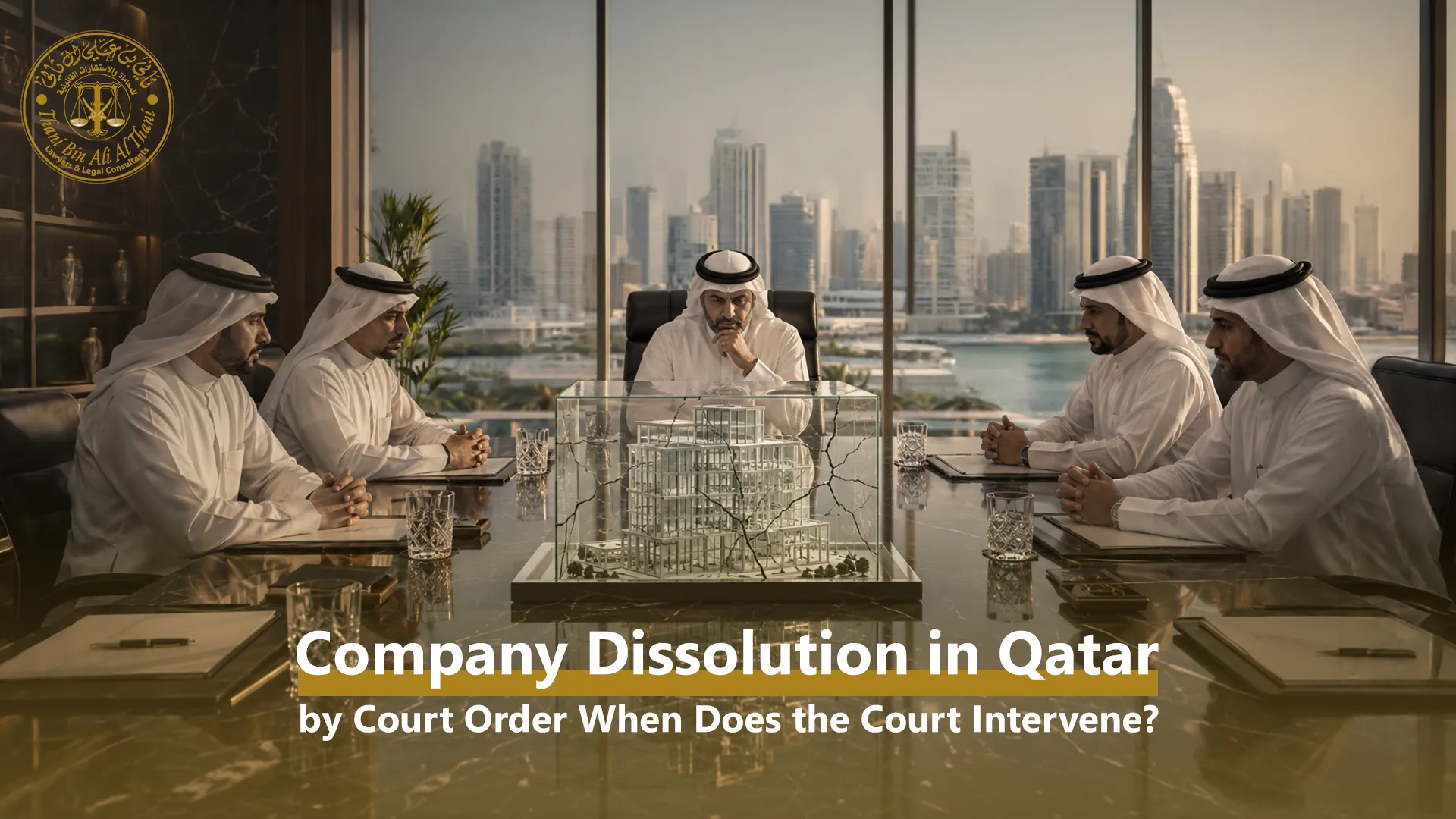

Although a company may appear to be nothing more than an agreement between partners or shareholders, in legal reality, it is an independent entity with its own legal personality, separate financial patrimony, and distinct rights and obligations.

For this reason, the law does not treat the dissolution of a company as a routine administrative decision. Rather, it is a structured legal process designed to protect the interests of shareholders, creditors, and all parties dealing with the company.
This is why understanding company dissolution in Qatar is essential. Under the Qatari Commercial Companies Law, a company may be dissolved:
- By the agreement of its partners.
- By operation of law.
- Require judicial intervention when the company’s continued existence becomes impossible or unlawful.
Read also: Are Electronic Board of Directors Meetings Legal in Qatar in 2026?
Can a Court Order the Dissolution of a Company?
Yes. The competent court in Qatar may order the dissolution of a company in specific circumstances prescribed by law, particularly where:
- There are serious grounds that make the company’s continued existence impossible.
- The company’s management is unable to effectively manage its affairs.
- The competent corporate bodies fail to adopt the decisions required by law.
- Legal circumstances arise that make it unlawful for the company to continue operating.
However, it is important to note that the dissolution of a company in Qatar does not result in its immediate cessation. Rather, upon dissolution, the company enters the liquidation stage, and its legal personality continues to exist to the extent necessary to complete the liquidation process and settle its rights and liabilities.
The governing principle is that the courts do not intervene to dissolve a company merely because one of the parties no longer wishes to continue the business. Once a company acquires legal personality, it is no longer governed solely by the will of its partners. Instead, it becomes associated with a broader range of legal relationships involving creditors, existing contracts, employees, and other parties dealing with the company.
Accordingly, a court order for the dissolution of a company is not based simply on a partner’s desire to withdraw from the business relationship. Rather, it must be supported by a serious legal ground demonstrating that the company’s continued existence has become impracticable, unsafe, or inconsistent with the requirements of the law.
Why doesn’t a dispute between partners justify the termination of a company?
Some believe that the mere existence of a dispute between partners is sufficient to justify the termination of a company. However, the law does not adopt this view. Commercial disputes are common in many business ventures and may, at times, become serious. The question before the court is not:
Is there a dispute?
Rather,
Has the dispute made the company’s continued existence impossible, harmful, or unlawful?
Accordingly, the courts do not intervene merely because a dispute exists between the partners. Judicial intervention becomes warranted only where the dispute disrupts the company’s operations or causes substantial harm to the company or to third parties.
When Does a Dispute Become a Ground for Dissolution?
A dispute may constitute a legitimate ground for seeking the dissolution of a company in Qatar where it results in:
- The management ceasing to perform its duties.
- The impossibility of making core decisions.
- The continued disruption of the company’s business operations.
- Serious prejudice to the interests of the company or its creditors.
The Company’s Legal Personality: When Does It Begin and End?
With the exception of a joint venture, a company acquires legal personality upon its registration in accordance with the law. From that moment, it has a legal existence separate from that of its partners or shareholders.
Consequently, the company is empowered to:
- Enter into contracts in its own name.
- Own property.
- File lawsuits.
- Incur financial obligations.
However, this legal personality does not continue indefinitely. A company may be terminated for any of the following reasons:
- The expiration of its defined duration.
- The completion of the purpose for which it was established.
- The impossibility of achieving its purpose.
- The loss of most of the company’s assets.
- A merger into another company.
- A judicial order for the dissolution of the company.
- A declaration of bankruptcy.
At this stage, the dissolution of a company in Qatar is no longer merely a legal concept. Instead, it marks the beginning of a transitional phase preceding liquidation and the formal cessation of the company’s business activities.
Does the Company’s Legal Personality End Immediately Upon Dissolution?
The answer is no.
The law provides that a company retains its legal personality throughout the liquidation process to the extent necessary to complete the liquidation, including:
- Collecting its receivables.
- Settling its debts.
- Selling its assets.
- Distributing the remaining assets to the partners or shareholders.
Who May Apply for the Judicial Dissolution of a Company?
The mere existence of a legal ground for dissolution is insufficient unless the applicant has the legal standing and a legitimate interest to seek the company’s dissolution. The applicant may be a partner adversely affected by the company’s inability to continue its operations, a shareholder in a company whose ability to continue has been undermined, or any other interested party whose rights have been affected by the company’s continued existence despite its unstable legal status.
Accordingly, the court examines not only the ground for dissolution, but also the applicant’s relationship with the company and the extent to which the applicant’s legal position is affected by the company’s continuation or termination.
This distinction is important because the dissolution of a company in Qatar is not intended to be used as leverage in a commercial dispute. Rather, it is a legal action with far-reaching consequences for the company itself and for those connected with it, including its creditors and contracting parties.
Accordingly, the clearer the applicant’s interest and the better documented the grounds for dissolution, the stronger the application will be before the court. In this context, an application for the dissolution of a company in Qatar is not merely a means of resolving a dispute; rather, it is a legal remedy aimed at establishing that the company can no longer fulfil the purpose for which it was established.

When May an Application for the Dissolution of a Company Be Filed with the Court?
As a general rule, the decision to continue or dissolve the company rests with the partners or the general assembly. However, the court intervenes when the company’s internal mechanisms fail to resolve the matter.
Judicial dissolution may be sought in the following circumstances:
- The existence of serious grounds preventing the company from continuing.
- The company’s inability to operate under normal conditions.
- The company’s violation of fundamental legal requirements.
- The management’s failure to take the measures required by law.
In general partnerships, limited partnerships, and joint ventures, any partner may apply for the dissolution of the company where serious grounds justify such an application.
Serious grounds do not include mere disagreements between partners or differences of opinion regarding the management of the company. Rather, they refer to circumstances that render the company incapable of being managed in the ordinary course, defeat the purpose for which it was established, or pose a genuine threat to the interests of the company or third parties.
This may be reflected in the inability to make fundamental decisions, the continued suspension of business operations, a partner’s breach of a fundamental obligation, or a dispute that becomes a permanent obstacle to achieving the company’s purpose.
Accordingly, determining whether a serious ground exists requires careful judicial assessment. The court does not merely examine the existence of a dispute; rather, it examines its impact on the company’s continued existence and its ability to carry on its business.
Can the Court Order a Solution Other Than the Dissolution of the Company?
Yes. In certain cases, the court may determine that the problem is attributable to the conduct of a particular partner and may therefore order:
- The expulsion of the partner responsible for the situation.
- The continuation of the company among the remaining partners.
This solution may be adopted if it is more appropriate than dissolving the company entirely.
Read also: Corporate Criminal Liability: When Can a Company Be Held Criminally Liable Under Qatari Law in 2026?
Substantial Losses: Do They Automatically Lead to the Dissolution of a Company?
This is one of the most frequently asked questions.
Is Loss Alone Sufficient?
No. Losses are a natural part of business activity. However, the law intervenes when they reach a level that threatens the company’s financial stability.
The law does not regard losses as an automatic ground for the dissolution of a company. Rather, it intervenes when losses indicate that the company’s capital has been impaired or that management has failed to fulfil its duty to safeguard the company’s financial position.
Joint-Stock Companies
Where losses reach half of the company’s capital:
- The board of directors must convene an extraordinary general assembly.
- The general assembly must consider whether the company should continue or be dissolved.
- If the meeting is not convened or no decision can be reached, any interested party may apply to the court for the dissolution of the company in Qatar.
Limited Liability Companies
Where losses reach half of the company’s capital:
- The managers must convene the general assembly within thirty days.
- The general assembly considers the matter of covering the capital or the dissolution of the company.
- The managers may incur legal liability if they fail to fulfil this duty.
Reduction in the Number of Shareholders: Does It Lead to Dissolution?
It may appear to be a mere procedural matter; however, it is one of the important grounds that may lead to the dissolution of a company in Qatar.
If the number of shareholders in a joint-stock company falls below the statutory minimum, the law grants the company an opportunity to rectify the situation. This may be achieved by:
- Increasing the number of shareholders.
- Converting the company into another suitable legal form.
However, if the situation remains unremedied for one full year, any interested party may petition the court for the judicial dissolution of the company.
The Difference Between Dissolution, Liquidation, and Deregistration
One of the most common areas of confusion among business owners is the distinction between:
First: Dissolution
It occurs when a legal ground arises, leading to the termination of the company’s original business activity.
Second: Liquidation
It is the phase during which the following actions are carried out:
- Identifying the company’s assets.
- Collecting outstanding receivables.
- Settling debts.
- Distributing the remaining assets to those entitled to them.
Third: Deregistration
Deregistration is the final step, which takes place after the liquidation has been completed and the company’s records have been formally closed in the Commercial Register.

How Does the Law Distinguish Between Dissolution, Liquidation, and Deregistration?
The law does not regard corporate distress as a single, direct ground for dissolution. Rather, it distinguishes between the existence of a ground for dissolution, the commencement of liquidation, and the termination of the company’s legal existence through deregistration.
The following table illustrates this legal progression:
| Stage | Legal Question | Practical Effect |
|---|---|---|
| Dissolution | Has a legal ground for dissolving the company arisen? | The company ceases to pursue the purpose for which it was established. |
| Liquidation | How are the company’s rights and liabilities to be settled? | A liquidator is appointed, or the liquidation continues in accordance with the procedure prescribed by law. |
| Deregistration | Has the liquidation been completed and has the company’s legal existence been terminated? | The company’s registration is removed from the Commercial Register upon completion of the required procedures. |
The purpose of this table is not merely to provide formal definitions, but to illustrate the legal progression from the occurrence of a ground for dissolution, through the commencement of liquidation, to the company’s final legal extinction by deregistration.
What Happens After a Company Is Dissolved by Court Order?
Following a judgment ordering the dissolution of a company in Qatar, the company no longer continues its original business activity in the ordinary course. Instead, it enters the liquidation stage, whose primary purpose is to settle the existing legal positions.
During this stage, the role of the company’s ordinary management is replaced by that of the liquidator, who is responsible for identifying the company’s assets, collecting its rights, settling its liabilities, and representing the company to the extent necessary for the liquidation process.
If the liquidation is based on a court ruling, the court plays a role in determining the liquidation method and appointing the liquidator when necessary.
This means that a judgment ordering the dissolution of a company does not leave it in a legal vacuum. Rather, it places the company under a different legal framework aimed at ensuring the orderly settlement of its obligations, rather than merely bringing its business activities to an end.
For this reason, understanding what follows the dissolution of a company in Qatar is just as important as understanding the grounds for dissolution, since the liquidation stage determines how the company’s rights and obligations are ultimately settled.
The Court’s Role in a Company Dissolution Lawsuit
When the court considers a claim for the dissolution of a company in Qatar, it does not merely examine whether a legal ground for dissolution exists. Rather, it balances a number of considerations, including:
- The interests of the company.
- The interests of the partners.
- The rights of creditors.
- The stability of commercial transactions.
Accordingly, the court may:
- Order the dissolution of the company.
- Dismiss the claim.
- Order the exclusion of a particular partner while allowing the company to continue.
- Appoint a judicial liquidator where necessary.
What Should Be Assessed Before Filing a Dissolution Claim?
Before initiating legal proceedings, it is advisable to answer a number of important questions:
Questions to Be Asked
- What type of company is it?
- Is the ground for dissolution related to the company as a whole or to a specific partner?
- Have the losses been substantiated by financial evidence?
- Has the competent general assembly been convened?
- Are there any outstanding debts or liabilities?
- Are there less harmful alternatives to dissolution?
- Can the company be restructured, or can a partner exit the company instead of dissolving it?
Answering these questions helps determine whether seeking the dissolution of a company in Qatar is the most appropriate legal course of action.
When Does Judicial Dissolution Become Necessary?
Judicial dissolution becomes necessary when a company reaches a stage at which it can no longer continue operating, either legally or practically. Common examples include:
- The complete breakdown of management as a result of disputes.
- Losses reaching statutory limits without the required measures being taken.
- The number of shareholders remaining below the statutory minimum for an extended period.
- The necessity for an organized judicial liquidation.
- The impossibility of achieving the purpose for which the company was established.
In such circumstances, the court’s intervention serves to reorganize the company’s legal position and protect the various rights associated with it.
Hence, it becomes evident that the dissolution of a company in Qatar is not a punitive measure, but rather a legal mechanism for addressing a situation that is no longer capable of continuing.
Read also: Sustainability of Family Companies in Qatar under Law No. 8 of 2021
Frequently Asked Questions About Company Dissolution in Qatar
Can a claim for the dissolution of a company be brought where the dispute is solely between the partners?
Not merely because a dispute exists. Rather, only where the dispute disrupts the company’s operations, renders its continued operation impossible, or causes serious prejudice to the company’s interests or the interests of third parties.
Are losses alone sufficient to justify dissolution?
Not necessarily. It depends on the extent of the losses and the measures taken by the management and the General Assembly to address the situation.
Can a single partner request the dissolution of the company?
Yes, in certain types of companies, provided that serious grounds exist to justify such an application under the law.
Does a judgment ordering the dissolution of a company mean that the company immediately ceases to exist?
No. The company enters the liquidation stage, and its legal personality continues throughout that stage.
Can the court reject a request for dissolution?
Yes, if it finds that the grounds are insufficient or that other remedies are available that are less detrimental than dissolving the company.
Accordingly, the dissolution of a company in Qatar should not be viewed merely as a legal conclusion, but rather as a legal mechanism for organizing an exit from a commercial situation that is no longer sustainable, without prejudicing the interests of partners, creditors, or market stability.

Final Remarks on Company Dissolution in Qatar
The dissolution of a company in Qatar is not merely a procedure for ending the relationship between partners; rather, it is a comprehensive legal mechanism that balances multiple interests, including those of partners, creditors, and persons dealing with the company.
For this reason, the judiciary does not intervene merely because of a dispute or a temporary loss. Judicial intervention becomes necessary when the company’s continued operation is no longer viable, when management fails to perform its legal duties, or when the company no longer meets one of the statutory requirements for its continued existence.
Furthermore, dissolution does not immediately end the company’s legal existence; rather, it initiates the liquidation stage, during which rights and liabilities are settled in an orderly and equitable manner to protect all parties connected with the company.
Ultimately, the dissolution of a company is not triggered by losses alone or by a temporary dispute. It arises when the company’s legal and administrative framework can no longer maintain its continuity or protect the interests of those dealing with it.