

Electronic Arbitration: Concept and Fundamentals
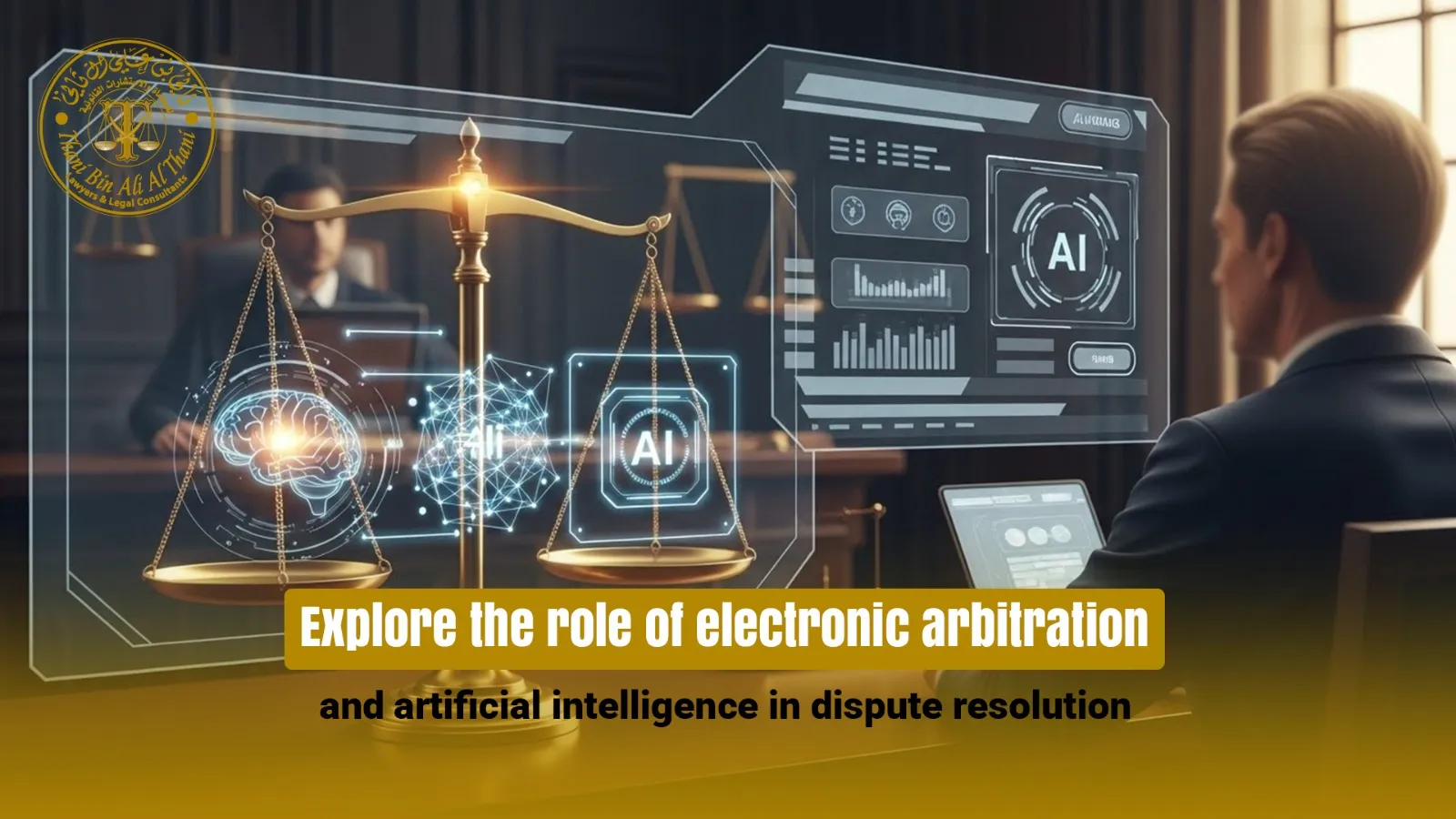
The rapid technological development currently being witnessed around the world is a key driver in the development of legal systems, with e-arbitration and artificial intelligence emerging as innovative tools for dispute resolution, moving beyond traditional complexities.
Have you ever wondered how technology can ensure swift and effective justice? The integration of digital arbitration mechanisms with artificial intelligence technologies opens up new horizons for companies and individuals seeking to resolve their disputes with the utmost efficiency and accuracy.
In this article, we provide an in-depth review of the concept of arbitration and highlight the key differences between arbitration and litigation.
We then discuss how electronic means and artificial intelligence have become an integral part of the private justice system, focusing on the provisions of the Qatari Arbitration Law No. (2) of 2017.
Electronic Arbitration: Concept and Legal Fundamentals
At its core, arbitration is a non-judicial system based on the consensual agreement of the parties in dispute over a particular matter, whether legal or material, civil or commercial.
Electronic arbitration and artificial intelligence as tools for dispute resolution require that conciliation be permissible with respect to the matter in dispute. The primary purpose of arbitration is to resolve conflicts as an alternative to resorting to traditional litigation.
This applies regardless of whether the body responsible for the proceedings is:
- A permanent arbitration Center.
- A body specially constituted for this purpose.
Read also: The powers of the natural judge in arbitration cases
The Essential Difference Between Arbitration and Traditional Judiciary
Arbitration does not differ in essence from the judiciary in terms of outcome.
Although both aim to achieve justice, there are fundamental differences that must be taken into account:
- Consensual Nature: Arbitration is a voluntary mechanism that reflects only the will of the disputing parties, whereas litigation is a mandatory process reflecting the sovereignty of the state.
- Procedures: Arbitration requires the formation of an arbitral tribunal, the selection of its members, the notification of arbitrators and the disputing parties regarding hearings, and the issuance of the arbitral award.
- Process: As is often said, “Arbitration begins with agreement, proceeds through procedure, and ends with judgment,” which provides a level of flexibility not typically found in ordinary courts.
Permissibility of Using Electronic Means in Arbitration
The Qatari Arbitration Law has introduced a qualitative shift by permitting the use of modern technological means at all stages of the proceedings.
Pursuant to Article (4) of the Arbitration Law, proceedings may be conducted through:
- Email: or any other communication method that allows written proof of delivery.
- Recording of Hearings: The law permits the documentation of hearings, meetings, and inspections in official minutes. It also allows these records to be captured in audio or video format using appropriate digital means.
This reliance on technology sets the stage for combining electronic arbitration and artificial intelligence into a single, cohesive system that ensures transparency and thorough documentation of every aspect of a dispute.

Artificial Intelligence: Definition and Role in the Legal System
Artificial intelligence (AI) is defined as the science and engineering of creating intelligent machines that emulate human behavior in reasoning, inference, and decision-making.
In the context of electronic arbitration and AI, two key features of this technology stand out:
- Learning and Perception: By feeding the system with prior data and legal statutes, it becomes capable of understanding complex legal texts.
- Autonomy in Providing Suggestions: The system can independently conduct research and reasoning to offer precise responses and suggestions to the user based on prior information.
Read also: Beware of defaming others electronically: The crime of online slander and libel in the digital age
The Complementary Relationship Between Electronic Arbitration and Artificial Intelligence
E-arbitration provides the digital environment in which disputes are resolved online, while artificial intelligence serves as the intelligent engine that drives and enhances this environment.
The digital system applies the rules of conventional arbitration but adds the feature of “full digitization,” which includes:
- Submitting an electronic arbitration request.
- Exchanging documents, evidence, and memoranda electronically.
- Conducting hearings via video conferencing technologies.
- Issuing the final award and publishing it online.
Artificial intelligence in this process acts as a “smart assistant” to both the arbitral tribunal and the disputing parties. Its contributions include:
- Enhancing the quality of legal research: By providing rapid access to governing texts and laws, both substantive and procedural.
- Document analysis: Offering the ability to thoroughly examine documents submitted by the parties and, if necessary, translate them instantly.
- Drafting award summaries: Assisting in accurately narrating the facts and reasoning of awards based on the evidence presented, thereby reducing the likelihood of human error.
Frequently Asked Questions About Electronic Arbitration and Artificial Intelligence
-
Are awards issued through electronic arbitration legally binding?
Yes. Awards issued within the framework of electronic arbitration and artificial intelligence carry the same legal authority as traditional arbitration awards, provided that the procedures prescribed by law and the parties’ agreement have been followed.
-
Does artificial intelligence replace the human arbitrator?
Currently, artificial intelligence serves as a tool to enhance efficiency rather than as a full substitute. Human arbitrators remain responsible for making the final decision, while AI undertakes tasks such as legal analysis, research, and the preparation of draft awards.
-
How does electronic arbitration ensure data privacy?
Advanced arbitration centres rely on high-level encryption protocols and digital protection for submitted documents, making them in some cases more secure and confidential than traditional paper files.
-
What types of disputes are suitable for electronic arbitration?
Electronic arbitration is ideal for disputes arising from electronic transactions, digital contracts, and international trade where the parties are located in different countries, thus saving on travel and accommodation costs.
-
Is it permissible to record arbitration hearings in audio and video?
Yes. The Arbitration Law allows the use of appropriate technological means to record proceedings and inspections, which enhances the accuracy of the arbitration process and provides a reliable reference for the arbitral tribunal.
Conclusion
The relationship between e-arbitration and AI is inherently complementary, aiming to deliver swift and effective justice.
The law not only permits e-arbitration but also paves the way for the use of advanced technologies to enhance the efficiency of dispute resolution.
Artificial intelligence is not merely a technological luxury; it is a necessity for providing arbitration solutions that keep pace with the fast-moving modern era, ensuring that disputing parties obtain their rights through human arbitrators supported by technological tools that guarantee accuracy and impartiality.
Ultimately, e-arbitration and AI remain the cornerstones of digital justice, contributing to lower costs, shorter resolution times, and higher-quality legal awards, thereby promoting the stability of legal and commercial transactions.